

⚡ Quick Decision Matrix
- Choose Gratitude Journaling if: You are experiencing Cognitive Stress (racing thoughts, past-focused regret, or need for emotional clarity).
- Choose Coloring Books if: You are experiencing Sensory Overload (burnout, decision fatigue, or need for immediate digital detox).
1. The Neurobiology of Modern Stress
To understand which practice is superior for you, we must examine the Prefrontal Cortex (PFC) and the Amygdala. Modern stress keeps our brain in a state of high-alert, often referred to as the "Tired but Wired" syndrome.
Journaling & "Affect Labeling"
Gratitude journaling utilizes a psychological process called Affect Labeling. When you physically write down an emotion or a positive event, you shift brain activity from the reactive Amygdala to the Ventrolateral Prefrontal Cortex. This transition literally "cools down" your nervous system, transforming abstract anxiety into concrete, manageable data.
Coloring & The "Flow State"
Adult coloring, conversely, triggers a Focus-Shift. By engaging in the geometric symmetry of botanical or mandala patterns, you quiet the Default Mode Network (DMN)—the brain's "auto-pilot" responsible for rumination. This induces Alpha Brainwaves, the same frequency achieved during deep mindfulness meditation, but with a much lower barrier to entry.
Get our "Nightly Ritual" Starter Pack
Download our printable 2-in-1 page: High-resolution gratitude prompts surrounded by cozy illustrations to color.
⬇ DOWNLOAD FREE PDF (300 DPI)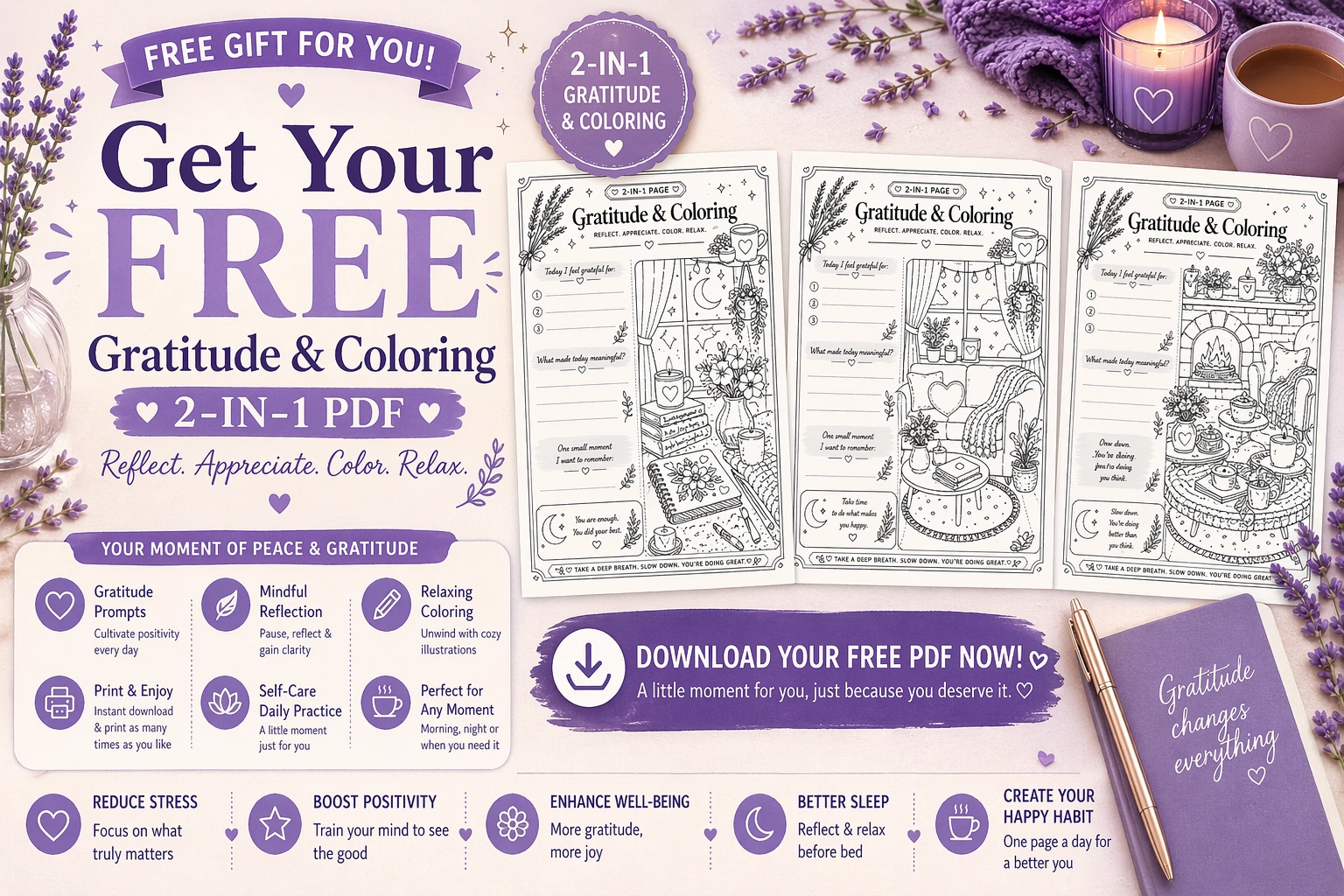
2. Comparative Analysis: Pros, Cons & ROI
| Feature | Gratitude Journal | Cozy Coloring |
|---|---|---|
| Neurological Target | Prefrontal Cortex (Logic) | Amygdala (Emotion) |
| Primary Benefit | Long-term Resilience | Instant Cortisol Drop |
| Entry Barrier | Requires mental effort | Zero effort / Intuitive |
3. Which Tool Matches Your Profile?
The "Ruminator"
If you replay conversations and worry about "what-ifs," Journaling provides the emotional closure your brain craves.
The "Burnout Survivor"
If you take decisions all day and feel mentally "fried," Coloring offers a tactile sanctuary with zero demands.
4. The 30-Day "Neural Reset" Strategy
To see lasting changes in your Vagal Tone and sleep quality, follow this science-backed roadmap:
- Days 1-7: The Sensory Bridge. Focus only on coloring for 15 minutes before bed. No screens allowed.
- Days 8-21: The Gratitude Seed. After coloring, write down exactly 3 things that went well. Be specific.
- Days 22-30: The Habit Integration. Notice which practice you feel more "pulled" toward on high-stress days.
Expert Q&A
Is coloring just a distraction?
Technically, it is "constructive distraction." Unlike scrolling social media, coloring engages the parietal lobe and fine motor skills, which forces the brain to stay in the present moment, effectively retraining your focus.
Why does gratitude journaling feel hard sometimes?
This is called "hedonic adaptation." Your brain gets used to the good things. To fix this, focus on micro-gratitudes: the smell of coffee, a warm blanket, or a 1-minute quiet moment.