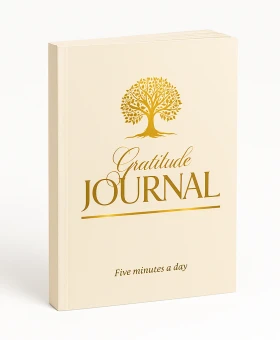

What is a gratitude journal?
A gratitude journal is a notebook for writing down a few things you appreciate—small moments, kind gestures, quiet wins, or simple comforts. It’s not about pretending everything is perfect. It’s about building a steadier perspective by noticing what supports you, even on messy days.
If you’ve searched for a daily reflections journal or a daily reflective journal, you’re usually looking for the same thing: a simple way to pause, process, and reset. A guided gratitude journal makes this easier because prompts remove the pressure of a blank page.
Why gratitude journaling works for busy adults
Most days run on autopilot—messages, tasks, decisions, and mental to-do lists. A 5-minute gratitude journal creates a small break in that loop. You slow down, name what mattered, and give your mind a soft landing instead of more noise.
Over time, consistent daily reflection can make stress feel more manageable, improve focus, and help you feel more grounded—without forcing positivity.
What people notice when they journal consistently
1) A calmer end to the day
A short entry helps your mind settle. Many people use a daily reflections journal as an evening ritual to close the day with clarity.
2) More awareness of what actually helps
Prompts make patterns visible—what supports your energy, what drains it, and what you’re doing better than you think.
3) Stronger appreciation for others
Regular reflection makes it easier to express gratitude through messages, small actions, and kinder self-talk.
4) A habit that feels doable
This 5-minute gratitude journal for adults fits into real life—even on busy, low-energy days.
How to start gratitude journaling (keep it simple)
- Pick a moment: morning or evening—choose what repeats easily.
- Write 1–3 small things: details matter more than big events.
- Add one sentence: what changed because of it today?
- Return gently: consistency grows from kindness, not pressure.
Simple gratitude prompts to try today

Use one prompt a day. A daily reflective journal works best when it’s light, not overwhelming.
- What’s one quiet moment today that felt good?
- Who made my day a little easier?
- What did I handle better than expected?
- What ordinary thing am I grateful for right now?
- What would I like to remember from today?
What makes a gratitude journal enjoyable
The best gratitude journals for adults remove friction and make returning easy. These features help you keep the habit:
So starting never feels overwhelming.
Missing a day doesn’t feel like failure.
Enough room for honesty, not perfection.
A layout that supports reflection.
Common doubts (you’re not alone)
“I don’t know what to write.”
Start small: one moment, one person, or one tiny win is enough. A guided daily reflections journal removes guesswork.
“I skip days and then stop.”
That’s normal. Undated pages and short entries make restarting easier. The habit is “returning,” not “never missing.”
“It feels forced or fake.”
Go specific. Concrete details feel real: “hot coffee,” “a text from a friend,” “five quiet minutes.”
Gratitude journaling FAQ
How long should I write?
3–5 minutes is enough. The goal is consistency, not length. A 5-minute gratitude journal is designed for real life.
Morning or evening?
Both work. Morning sets intention; evening helps you decompress. Choose what you can repeat most days.
Are guided gratitude journals good for beginners?
Yes. Prompts remove friction and help you build a steady daily reflection habit without overthinking.
Is this the same as an “adult coloring journal”?
Not exactly. This page focuses on gratitude journals and daily reflections. If you want a journal that combines reflection with relaxing art time, explore our coloring journal collection separately.